
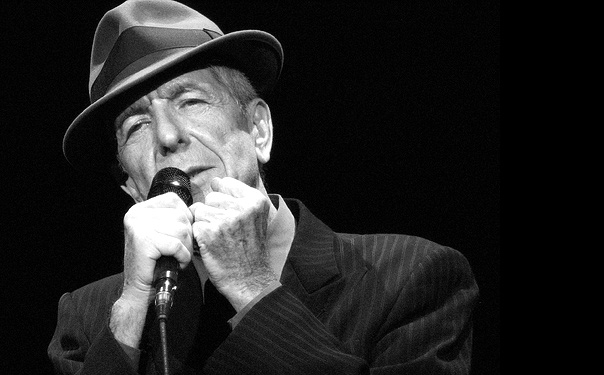
We lost a generational talent last night, but Cohen isn’t about to fade with the tides of history.
Leonard Cohen died yesterday at the age of 82, just weeks after releasing his final album You Want It Darker. It took mere minutes for the eulogies and remembrances to start rolling out, revealing the crass reality of our times: they were pre-written.
It’s hard to blame writers for getting them ready for publication. In one of his final interviews, in this incredible profile in the New Yorker, Leonard Cohen told David Remnick “I am ready to die,” an out-of-context quote that got passed around on music sites until he clarified “I intend to live forever.”
It turns out both statements were true at the same time. After a richly lived, deeply felt life, L. Cohen has signed off sincerely, leaving his words and melodies to the canon, to be listened to, pored over and discussed like Talmud.
He may have left us at a particular volatile time for the world, and in a year where so many other legends were lost, but his loss stands apart. Death and mourning have been major themes in his life and work, lodging right alongside longing and loneliness, sex and God. Leonard Cohen the man may have literally died, but he will, indeed, live forever.
Here’s why:
He lived his life like it was poetry
A literary sensation from before he started playing music, critics were quick to equate the narrator of Leonard Cohen’s work with Leonard Cohen himself, so he went full force with it. His “Famous Blue Raincoat,” his years on Hydra, even the head he received at Chelsea Hotel — Leonard was so often the man in his songs, yet he wrote himself to live beyond the page and beyond the record.
Just take his final act, the letter he wrote to the famous Marianne Ihlen(of “So Long, Marianne”) on her deathbed this past summer, as relayed by the filmmaker Jan Christian Mollestad:
“Well Marianne it’s come to this time when we are really so old and our bodies are falling apart and I think I will follow you very soon. Know that I am so close behind you that if you stretch out your hand, I think you can reach mine.”
He wrote his own afterword
It’s easy to marvel at how David Bowie orchestrated his own final act with ★ and compare it to You Want It Darker. “Hineni, Hineni,” he recites on the title track, echoing what Abraham said to God when he called upon him (in English: “Here I am”). “I’m ready, my Lord.”
But while Bowie spent his final act writing his afterworld, Leonard Cohen spent his whole career doing that. It’s telling that you can’t pick one song to memoralize him. Is it “Death of a Ladies’ Man”? What about “Closing Time”? Or do you go with the inevitable “Hallelujah”? And if so, who sings it?
He resisted earthly recognition
Long before Bob Dylan won the Nobel Prize and sparked a debate over whether songwriting should be considered literature (Cohen’s own response: “To me, [the award] is like pinning a medal on Mount Everest for being the highest mountain.”), Leonard Cohen was awarded the Governor General’s Award for his poetry. He refused. “Much in me strives for this honour,” he wrote in a telegram, “but the poems themselves forbid it absolutely.”
It was the first of many self-deprecating acceptance speeches (or declination speeches).
His 1993 Juno for Best Male Vocalist: “”Only in a country like this with a voice like mine could I receive such an award.”
His 2008 induction into the Rock & Roll Hall of Fame: “I am reminded of the prophetic statement by Jon Landau in the early 1970s: ‘I have seen the future of rock’n’roll, and it is not Leonard Cohen’.”
So his admirers had to find new ways to honour him. In 2010, 32 years after he refused the Governor General’s Award, a Facebook petition suggested a better award: the Governor General post itself. No word if he got the message, but you can only imagine how he might have declined.
He was never a natural, but he looked like it
When I saw Leonard Cohen in 2012, it was an incredible show. He played a marathon three hour set, indulging the crowd in songs from all over his careeer, even “Hallelujah,” while displaying his trademark elegance, grace and humour. He was 78, but he was in the peak of his career as a showman.
It wasn’t always that way. Early in his career, Cohen suffered from severe stage fright. Maybe his most famous performance, when he soothed and mesmerized a restless crowd at the Isle of Wight festival, he was sedated himself on Quaaludes. It wasn’t until after he was forced out of retirement in 2008 (when he realized his manager Kelley Lynch had been stealing from him) that he discovered the joy in playing his songs for an audience. He was on tour pretty much continuously from then until 2013. If he didn’t enjoy it, he was a very good actor.
The truth is, Cohen never embodied the prevailing myth of the natural writer, the conduit genius through whom great art just flowed. Take this anecdote from Remnick’s New Yorker profile comparing him to Dylan:
Dylan recognized the beauty of [“Hallelujah”‘s] marriage of the sacred and the profane. He asked Cohen how long it took him to write.
“Two years,” Cohen lied.
Actually, “Hallelujah” had taken him five years. He drafted dozens of verses and then it was years more before he settled on a final version. In several writing sessions, he found himself in his underwear, banging his head against a hotel-room floor.
Cohen told Dylan, “I really like ‘I and I,’ ” a song that appeared on Dylan’s album “Infidels.” “How long did it take you to write that?”
“About fifteen minutes,” Dylan said.
He was born old
Cohen connected to younger generations despite appearing old because, basically, he was always old. He was already 33 by the time he released his first album, having already established himself (reputationally, not financially) as a poet and novelist. He always seemed older than his other boomer peers, but he eventually learned to play the role with grace. Whether playing the lecherous old man or the wise, elegant older gentleman, Cohen made his age a major element of his persona. His earlier guitar songs were great, don’t get me wrong, but they didn’t sound quite right until his voice lowered to suit that persona.
That may have accounted for his cross-generational appeal, inspiring tribute albums throughout his life that roped in everyone from Pixies and REM to more obvious acolytes like Nick Cave and Rufus Wainwright.
My father, who was also a Jewish Montrealer when Cohen was rising to prominence, says his run-in with Cohen at the CBC in the ’70s was the only time he’s ever been starstuck. “I couldn’t think of anything to say,” he told me on the phone last night when I called him to trade favourite lyrics, “I was in such awe.”
He was rock’s consummate ladies’ man
Leonard Cohen may not have invented his brand of masculinity — sensitive, witty, quietly charismatic, alternately self-confident and self-deprecating, only occasionally lewd, the exception for women who preferred handsome men — but he exemplified it. Some people have painted it as toxic (Sylvie Simmons’ otherwise fawning biography I’m Your Man certainly hints at it), but at least his muses have achieved their own notoriety.
From Marianne to Suzanne (#1 and #2), they’ve become well-known to any complete Cohenfile. And he’s hinted they’re more than just inspiration. Marianne Ihlen, for instance, appears on the back coverof his second album Songs From A Room, seated at his place before the typewriter.
His words were biting and often funny
You think of Cohen, you think of death and depression. But he also had a sharp sense of humour (what else to make of a lyric like “I was born with the gift of a golden voice” or all of “Don’t Go Home With Your Hard-On”), and an even sharper eye for politics. For Cohen, political commentary wasn’t tied to names or figures so much as the greater greed and corruption of humanity itself, but considering the timing of his death, it’s hard not to pull out some of the more biting gems.
Everybody knows that the war is over
Everybody knows the good guys lost
Everybody knows the fight was fixed
The poor stay poor, the rich get rich
That’s how it goes
Everybody knows
or
Sail on, sail on
O mighty ship of state!
To the shores of need
Past the reefs of greed
Through the squalls of hate
Sail on, sail on, sail on…
Clearly, he couldn’t live in a world where Trump was president.
Okay, “Hallelujah”
Post-Jeff Buckley, “Hallelujah” has become a cliché, the kind of song that gets played at auditions on singing shows or in heavy-handed music cues in comic book movies. It’s the only song of his that’s inspired entire book-length studies, and the only one our man has personally called for a moratorium on. But that doesn’t mute its brilliance. It lives way beyond him, but “Hallelujah” might be the quintessential Leonard Cohen song: a nuanced mix of God and sex, Biblical allusion and humor, the profound and the profane. If it is his one song that sighs eternally, history can do worse.